

Best Wi-Fi Routers of 2026
Seven routers we'd actually buy – for freeze-free video calls, whole-home coverage, small business networks, and tight budgets.
Your router is the single most important piece of technology in your home office, and the one most people never think about until a video call freezes at the worst possible moment. Every email, every Zoom meeting, every cloud backup and file upload passes through it. A great laptop or monitor cannot fix a weak, overloaded connection, which is why choosing the best Wi-Fi router for your home is often the highest-impact change you can make to your whole setup.
In this guide to the best Wi-Fi routers 2026 has to offer, we focus on what actually matters for remote work and small business: rock-solid stability for video conferencing, enough capacity for a house full of devices, strong coverage that reaches every corner, and security you do not have to think about. We have picked seven routers for seven different needs and budgets, from a no-fuss budget pick to a flagship Wi-Fi 7 powerhouse, so you can find the right one in a couple of minutes and get back to work.
Modern Wi-Fi has come a long way. Wi-Fi 6 brought big gains in handling many devices at once, Wi-Fi 6E added a clean new 6 GHz lane, and Wi-Fi 7 now layers on even wider channels and Multi-Link Operation for lower lag and steadier connections. We explain all of that in plain English below, and tell you exactly when it is worth paying for and when it is not, so you can pick the best Wi-Fi router for your budget.
THE SHORT ANSWER
- Best overall: the ASUS RT-BE9700 gives most home offices tri-band Wi-Fi 7, dual WAN for failover, and free lifetime security at a sensible price.
- Best value: the GL.iNet Flint 2 delivers fast Wi-Fi 6, dual 2.5G ports, and subscription-free security for noticeably less.
- Tight budget: the TP-Link Archer AX21 covers a smaller home or apartment well for under a hundred dollars.
- Big house or dead zones: go mesh with the TP-Link Deco 7 Pro BE63 or, for the largest homes, the Amazon eero Max 7.
Best Wi-Fi routers 2026 at a glance
Here is the quick comparison of the best Wi-Fi routers. Prices move around, so tap any product card further down to see the current Amazon price before you buy.
Affiliate disclosure: the product links below are Amazon affiliate links. Smart Tech Buying may earn a commission if you buy through them, at no extra cost to you. This never affects which products we pick or how we rank them.




The 7 best Wi-Fi routers for 2026
1. ASUS RT-BE9700 — Best Overall
- Beyond-fast WiFi 7 (802.11be) – 320MHz channels in the 6 GHz band and 4096-QAM significantly increase network capacity a…
- Multi-link Operation – Link to multiple bands at the same time to ensure stable internet connections and efficient data …
- Versatile WAN configuration options – Establish always-on internet through AI WAN detection and a convenient USB port re…
The ASUS RT-BE9700 is the router we would put in most home offices in 2026. It hits the sweet spot: genuine tri-band Wi-Fi 7 with a dedicated 6 GHz lane, rated speeds up to 9.7 Gbps, and two WAN ports so a backup internet line can take over if your main one drops. You are getting flagship-grade hardware and the easy management ASUS is known for, without paying flagship prices.
Why we recommend it: it is the rare router that is powerful enough to last for years yet simple enough that setup takes minutes through the ASUS app. Crucially for remote workers, ASUS includes lifetime AiProtection Pro security at no extra cost, so you are not pushed toward a monthly subscription to keep your network safe. Add AiMesh support so you can expand later, a built-in VPN, and dual WAN for failover, and it is the easiest router to recommend across the board. If you want a single device that simply works and will not feel slow in three years, start here.
✓ What’s great
- Tri-band Wi-Fi 7 with a clean 6 GHz lane
- Rated up to 9.7 Gbps
- Two WAN ports for internet failover
- Free lifetime AiProtection Pro security
- AiMesh-ready with a built-in VPN
✗ Watch outs
- Newer listing with a small review count so far
- More than a casual user needs for light browsing
- Upright design is a little bulky
- Wi-Fi standard: Wi-Fi 7 (802.11be), tri-band
- Top speed: up to 9.7 Gbps
- Ports: 2x WAN, gigabit LAN
- Coverage: AiMesh-expandable for larger homes
- Security: free lifetime AiProtection Pro + VPN
2. TP-Link Archer BE700 — Best Wi-Fi 7 Router
- 𝐁𝐥𝐚𝐳𝐢𝐧𝐠-𝐅𝐚𝐬𝐭 𝐁𝐄𝟏𝟓𝟎𝟎𝟎 𝐓𝐫𝐢-𝐁𝐚𝐧𝐝 𝐒𝐩𝐞𝐞𝐝𝐬: With speeds of up to 11528 Mbps on the 6GHz band, 2882 Mbps on the 5GHz band, and …
- 𝐍𝐞𝐱𝐭-𝐆𝐞𝐧 𝐖𝐢-𝐅𝐢 𝟕: Designed with the latest Wi-Fi 7 technology, featuring Multi-Link Operation, Multi-RUs, 4K-QAM, and up…
- 𝟏𝟎 𝐆𝐛𝐩𝐬 𝐏𝐨𝐫𝐭 𝐟𝐨𝐫 𝐌𝐮𝐥𝐭𝐢-𝐆𝐢𝐠𝐚𝐛𝐢𝐭 𝐂𝐨𝐧𝐧𝐞𝐜𝐭𝐢𝐯𝐢𝐭𝐲: Features one 10 Gbps WAN port, one 2.5 Gbps LAN port, and three 1 Gbps LAN …
When you want the fastest, most capable single router available and budget is not the deciding factor, the TP-Link Archer BE700 is the flagship to beat. This is a tri-band Wi-Fi 7 machine rated up to 15 Gbps across eight streams, with a true 10-Gig port and a 2.5-Gig port beside it, wrapped in a tidy tower with six internal antennas that looks at home on a desk rather than under one.
Why we recommend it: it is built for the most demanding home offices, the ones running multi-gig fiber, constant 4K video conferencing, huge file transfers, and a small army of smart devices at the same time. The dedicated 6 GHz band gives your newest laptops and phones a clean, fast lane to themselves, and Multi-Link Operation lets a device use more than one band at once for steadier, lower-latency connections. It runs both a VPN client and a VPN server, and carves off a Private IoT network so smart plugs and cameras stay away from your work machine. Pair it with a powerful machine from our best desktop computers guide and you have a setup that will not bottleneck.
✓ What’s great
- Tri-band Wi-Fi 7, eight streams up to 15 Gbps
- True 10-Gig port plus a 2.5-Gig port
- Dedicated 6 GHz band and Multi-Link Operation
- VPN client and VPN server built in
- Private IoT network and USB 3.0
✗ Watch outs
- Expensive, this is a premium flagship
- Top HomeShield features want a subscription
- Overkill for basic internet plans
- Wi-Fi standard: Wi-Fi 7 (802.11be), tri-band
- Top speed: up to 15 Gbps (BE15000)
- Ports: 1x 10G, 1x 2.5G, 2x 1G, USB 3.0
- Coverage: EasyMesh-expandable, 6 internal antennas
- Security: TP-Link HomeShield (optional subscription)
3. GL.iNet Flint 2 (GL-MT6000) — Best Value
- ***Please update the firmware upon initial setup of the router, as it greatly enhances the device’s performance and ensu…
- 【High Speed Gaming Router】Dominate with uninterrupted performance with the ultimate MT6000 gaming internet router, equip…
- 【Rapid OpenVPN & Wireguard speed】Wireguard VPN and OpenVPN speeds up to 900Mbps and 880Mbps respectively, giving you com…
Not everyone needs Wi-Fi 7, and the GL.iNet Flint 2 (GL-MT6000) is proof you can get a lot of router for the money. It is a dual-band Wi-Fi 6 machine built around fast wired networking, with two 2.5-Gigabit ports, a quad-core processor, and 1 GB of RAM, so it keeps a busy household of laptops, phones, and smart devices running smoothly without a flagship price tag. Reviewers and owners consistently rate it among the best value routers you can buy.
Why we recommend it: most homes and devices cannot yet take full advantage of Wi-Fi 7, so a strong Wi-Fi 6 router like this gives you the speed you will actually use while saving real money. The Flint 2 stands out for being genuinely subscription-free: high-speed VPN support (WireGuard and OpenVPN), network-wide ad blocking, and security controls are all built in at no extra cost, with none of the recurring fees some rivals charge. It runs flexible open-source firmware that power users love, while still being simple to set up through a clean web interface and mobile app. For the value-minded remote worker who also wants multi-gig wired ports, it is the smart-money pick.
✓ What’s great
- Outstanding speed and features for the price
- Two 2.5-Gigabit ports for fast wired devices
- Subscription-free VPN, ad-blocking, and security
- Flexible open-source firmware power users love
- Handles many devices and heavy calls with ease
✗ Watch outs
- Wi-Fi 6, not Wi-Fi 7 or 6E
- No 6 GHz band
- Advanced settings can feel deep for beginners
- Wi-Fi standard: Wi-Fi 6 (802.11ax), dual-band
- Top speed: up to 6,000 Mbps (AX6000 class)
- Ports: 2x 2.5G (WAN/LAN) + 4x gigabit LAN
- Key features: built-in WireGuard/OpenVPN, ad-blocking, OpenWrt firmware
- Security: subscription-free, no recurring fees
4. TP-Link Deco 7 Pro BE63 — Best Mesh Wi-Fi System

- 𝐅𝐞𝐚𝐭𝐮𝐫𝐞-𝐑𝐢𝐜𝐡 𝐖𝐢-𝐅𝐢 𝐁𝐮𝐢𝐥𝐭 𝐭𝐨 𝐋𝐚𝐬𝐭: Get expansive whole-home coverage, fast Wi-Fi 7 speeds, and a future-ready 10G WAN/LAN…
- 𝗩𝗮𝘀𝘁 𝗠𝗲𝘀𝗵 𝗖𝗼𝘃𝗲𝗿𝗮𝗴𝗲 & 𝗗𝗲𝘃𝗶𝗰𝗲 𝗖𝗮𝗽𝗮𝗰𝗶𝘁𝘆: The 2-pack mesh system covers up to a vast 5,800 sq.ft. and supports over 200 devi…
- 𝐁𝐄𝟏𝟎𝟎𝟎𝟎 𝐓𝐫𝐢-𝐁𝐚𝐧𝐝 𝐖𝐢-𝐅𝐢 𝟕 𝐒𝐩𝐞𝐞𝐝𝐬: Delivers up to 5,188 Mbps (6 GHz), 4,324 Mbps (5 GHz), and 574 Mbps (2.4 GHz) speeds fo…
If a single router cannot reach your whole home, a mesh system is the answer, and the TP-Link Deco 7 Pro BE63 is our favorite for 2026. This two-pack covers a large home in seamless tri-band Wi-Fi 7, rated up to 10 Gbps across six streams, so you move from your office to the patio to the bedroom on one network name with no drop-outs. It is the fix for the upstairs dead zone that turns your afternoon calls into a slideshow.
Why we recommend it: it pairs whole-home coverage with four 2.5-Gig ports on each unit, so you can run a wired backhaul between the nodes and keep every bit of wireless bandwidth for your devices. The 6 GHz band and Multi-Link Operation mean the units talk to each other on a clean lane rather than stealing capacity from your laptop. Setup is a three-step app process, and you can add more nodes later. The discreet white units look far better on a shelf than a typical antenna-covered router. For a large or multi-floor home office, this is the upgrade you feel every single day.
✓ What’s great
- Seamless whole-home tri-band Wi-Fi 7
- Rated up to 10 Gbps across six streams
- Four 2.5-Gig ports per unit for wired backhaul
- Clean, discreet design that hides easily
- Multi-Link Operation and easy app setup
✗ Watch outs
- Costs more than a single router
- Top HomeShield features want a subscription
- Two units take two outlets and good placement
- Wi-Fi standard: Wi-Fi 7 (802.11be), tri-band mesh
- Top speed: up to 10 Gbps (BE10000)
- Ports: 4x 2.5G per unit, wired backhaul
- Coverage: whole-home, 2-pack, expandable
- Security: TP-Link HomeShield + VPN
5. Amazon eero Max 7 — Best for Large Homes
- THE SPEED OF EERO MAX 7 – With two 10 Gigabit Ethernet ports, you can enjoy wired speeds up to 9.4 Gbps, wireless speeds…
- THE POWER OF WI-FI 7 TECHNOLOGY – Wi-Fi 7 technology can provide more than twice the speed of Wi-Fi 6, so you can enjoy …
- TRUEMESH RELIABILITY – Our patented TrueMesh network intelligence dynamically finds the ideal path for data transfer, li…
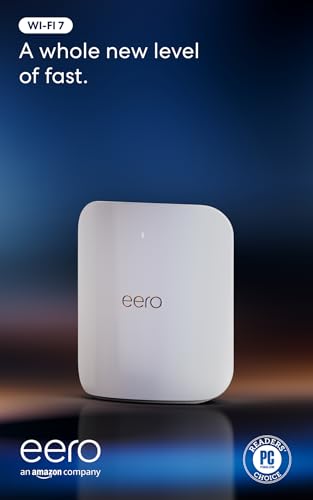
For the largest homes, and for anyone who wants whole-home Wi-Fi 7 with the least possible hassle, the Amazon eero Max 7 is hard to beat. Each unit covers up to 2,500 square feet and connects 250-plus devices, and because eero is a true mesh you can simply add more units, sold as 1-, 2-, and 3-packs, to blanket a sprawling house or even an outbuilding. Two 10-Gig ports per unit mean it is ready for the fastest internet you can get.
Why we recommend it: eero is famous for being the easiest mesh to live with. Setup through the app takes minutes, the patented TrueMesh software quietly routes every device along the best path, and it doubles as a smart-home hub for Thread, Matter, and Zigbee gadgets. That simplicity is perfect for a busy professional who wants reliable coverage and zero networking headaches. Just note that some advanced security and parental controls live behind the optional eero Plus subscription. For a big home that needs flawless calls in every room, it is the most stress-free whole-home answer, and a natural match for the gear in our home office monitors guide.
✓ What’s great
- Effortless setup and rock-solid reliability
- Expandable to cover very large homes
- Two 10-Gig ports per unit for fast internet
- Built-in smart-home hub (Thread, Matter, Zigbee)
- Backed by a three-year warranty
✗ Watch outs
- Best security and controls need eero Plus (paid)
- Fewer manual settings for tinkerers
- Premium price, especially in multi-packs
- Wi-Fi standard: Wi-Fi 7 (802.11be), tri-band mesh
- Top speed: wired up to 9.4 Gbps, wireless up to 4.3 Gbps
- Ports: 2x 10G per unit
- Coverage: ~2,500 sq ft per unit (expandable)
- Security: optional eero Plus subscription
6. ASUS ExpertWiFi EBR63 — Best for Small Business
- Separate and Secure Usage – Up to five SSIDs to separate and prioritize devices for different business scenarios.
- Customizable Guest Portal – Customize the SSID, portal type, brand name and templates to fit your business style.
- Backup WAN for Stable Connectivity – The USB port can be used as a backup WAN by connecting it to a mobile phone with ho…
Running a business, even a one-person operation, brings needs a home router does not cover: a separate guest network for customers, isolated traffic for point-of-sale or sensitive work, and a connection that never goes down. The ASUS ExpertWiFi EBR63 is built for exactly that. It is an all-in-one router, switch, and security gateway with business features, at a price a small business can actually afford.
Why we recommend it: it gives you up to five separate networks (SSIDs) with VLAN support, so staff, guests, and devices stay neatly walled off from one another, plus a customizable guest portal you can brand for a cafe or shop. A USB port acts as a backup internet connection via your phone’s hotspot, so a cable outage does not stop the workday. You also get commercial-grade AiProtection Pro security and full VPN support with no subscription fees, and you can scale up by adding ExpertWiFi nodes as you grow. For a home-based business or a small office, it is professional networking without the enterprise price tag or complexity.
✓ What’s great
- Up to 5 SSIDs with VLAN network separation
- Brandable guest portal for customers
- USB backup WAN for failover internet
- Free commercial-grade security and VPN
- Scales by adding ExpertWiFi nodes
✗ Watch outs
- Wi-Fi 6 (AX3000) speeds, not Wi-Fi 7
- Business features have a small learning curve
- Coverage suits offices, not sprawling homes
- Wi-Fi standard: Wi-Fi 6 (802.11ax), dual-band
- Top speed: up to 3,000 Mbps (AX3000)
- Key features: 5 SSIDs, VLAN, guest portal, USB backup WAN
- Capacity: ~100 devices, scalable to 12 nodes
- Security: free AiProtection Pro + VPN
7. TP-Link Archer AX21 — Best Budget

- DUAL-BAND WIFI 6 ROUTER: Wi-Fi 6(802.11ax) technology achieves faster speeds, greater capacity and reduced network conge…
- AX1800: Enjoy smoother and more stable streaming, gaming, downloading with 1.8 Gbps total bandwidth (up to 1200 Mbps on …
- CONNECT MORE DEVICES: Wi-Fi 6 technology communicates more data to more devices simultaneously using revolutionary OFDMA…
You do not have to spend a lot to get a real upgrade over the basic box your internet provider handed you. The TP-Link Archer AX21 is our favorite Wi-Fi 6 router under $100, and it punches well above its price. For an apartment, a smaller home, or a single-room home office on a plan up to a few hundred Mbps, it delivers fast, modern Wi-Fi 6 speeds and noticeably better range than a rental router.
Why we recommend it: it proves you can get the essentials done affordably. You get genuine Wi-Fi 6 efficiency for handling several devices at once, four gigabit LAN ports for wired gear, and a setup so simple through the Tether app that you will be online in minutes. It supports EasyMesh, so you can add a compatible unit down the road if you move somewhere bigger, and with more than 24,000 ratings it is one of the most thoroughly proven routers on Amazon. If money is tight or your needs are modest, this is the easy, sensible choice, and it frees up budget for the rest of your desk, like a webcam from our best webcams guide.
✓ What’s great
- Excellent value, usually under $100
- Real Wi-Fi 6 speed and efficiency
- Four gigabit LAN ports for wired gear
- Simple Tether app setup, 24,000+ ratings
- EasyMesh-ready to expand later
✗ Watch outs
- Dual-band only, no 6 GHz lane
- Gigabit (not multi-gig) ports only
- Not for large homes or heavy multi-user loads
- Wi-Fi standard: Wi-Fi 6 (802.11ax), dual-band
- Top speed: up to 1,800 Mbps (AX1800)
- Ports: 1x gigabit WAN, 4x gigabit LAN
- Coverage: apartments and smaller homes
- Security: TP-Link HomeShield, EasyMesh
How we chose the best Wi-Fi routers
Smart Tech Buying focuses on technology for remote work and small business, so we judged every router by what matters at a desk, not by marketing numbers. Here is what guided our picks.
Wireless performance and reliability. Raw speed is nice, but a steady, low-lag connection is what keeps a video call from freezing. We favored routers with strong real-world throughput and the consistency that remote work depends on. Coverage came next, because the fastest router is useless if the signal does not reach your office, so each pick is matched to a home size.
Security was a priority given how much sensitive work happens at home. We leaned toward routers with WPA3, automatic updates, and built-in protection, and we flagged clearly when the best features require a paid subscription. We also weighed ease of setup, because most people want to be online in minutes through an app, not buried in settings.
Finally, we balanced value and future-proofing. We did not assume pricier is better; the goal was the right router for each budget and need. Where Wi-Fi 7 and a 10-Gig port genuinely extend a router’s useful life, we said so, and where Wi-Fi 6 is the smarter spend today, we said that too. Every pick is a currently available model that we would be comfortable recommending to a friend setting up their home office.
Wi-Fi 6 vs Wi-Fi 7: what you actually need
This is the question shoppers ask most, so here is the plain-English answer. Wi-Fi 7 is the newest standard and it is genuinely faster, with wider channels, a roomy 6 GHz band, and Multi-Link Operation (MLO) that lets a device use more than one band at once for lower lag and steadier connections. Wi-Fi 6 (and 6E) is the previous generation, still excellent, more affordable, and supported by nearly every device you own today.
| Wi-Fi 6 / 6E | Wi-Fi 7 | |
|---|---|---|
| Top speed | Very fast for any home office | Faster, with wider 320 MHz channels |
| 6 GHz band | Only on Wi-Fi 6E models | Yes, with more capacity |
| Best feature | Great multi-device efficiency | MLO for lower lag and stability |
| Device support | Works with everything today | Newest phones/laptops only, for now |
| Cost | More affordable | Premium, but prices are falling |
| Future-proofing | Good for several years | Best for the long haul |
The bottom line: if you are buying a router you want to keep for five or more years, or you have multi-gig internet and the newest devices, Wi-Fi 7 (like the RT-BE9700 or Archer BE700) is worth it. If you want the best value today and your devices are a year or two old, a top Wi-Fi 6 router like the GL.iNet Flint 2 will feel just as fast for everyday work and save you money. There is no wrong answer, only the right fit for your devices and budget. For the full breakdown, see our dedicated guide to Wi-Fi 7 vs Wi-Fi 6.
Mesh Wi-Fi vs a traditional router
The other big decision is whether to buy one router or a mesh system of two or more units. The right choice comes down to the size and shape of your home, not your budget alone.
A traditional single router is often the best Wi-Fi router choice when your home office is in the same room as it or close by. One good unit, like the RT-BE9700 or GL.iNet Flint 2, delivers the fastest possible speed to nearby devices for less money, and it is simpler to manage. For apartments, smaller homes, and single-floor layouts, a single router is usually all you need.
A mesh system wins when one router cannot cover everything, think large homes, multiple floors, thick walls, or a home office at the far end of the house. Mesh uses several units that hand your devices off seamlessly as you move, on one network name, eliminating the dead zones that cause dropped calls. The TP-Link Deco 7 Pro BE63 and Amazon eero Max 7 are our mesh picks. The trade-off is a higher price and two or three units to place, but if you have ever lost a meeting because you walked into the wrong room, mesh is worth every penny. One tip: many single routers (including our ASUS picks) support AiMesh, so you can start with one and add a matching unit later if you need to.
Best Wi-Fi router: frequently asked questions
Do I need Wi-Fi 7 in 2026?
Not necessarily. Wi-Fi 7 is the fastest standard and the best choice if you have multi-gig internet, the newest devices, or you want a router to last five-plus years. But a top Wi-Fi 6 router still handles video calls, streaming, and a busy household beautifully for less money. Buy Wi-Fi 7 for future-proofing; buy Wi-Fi 6 for the best value today.
Is mesh Wi-Fi worth it?
If you have a large or multi-floor home, or dead zones where the signal drops, then yes, mesh is absolutely worth it. It blankets your whole home in one seamless network and ends dropped calls in far rooms. If your home is small or your office sits near the router, a single good router is the better value.
How often should I replace my router?
Most routers last about five to seven years before aging hardware and security limits start to show. If yours is more than five years old, predates Wi-Fi 6, or struggles with today’s device count, an upgrade is one of the cheapest, most noticeable improvements you can make to a home office.
What internet speed do I need for remote work?
For one remote worker, about 50 Mbps download and 10 Mbps upload is enough for smooth video calls. For a household with several people working, streaming, and gaming at once, aim for 200 Mbps or more download and 20 Mbps-plus upload. Just remember your router must be capable of delivering those speeds wirelessly.
Can a better router improve my video calls?
Yes, often dramatically. Freezes and dropouts are frequently caused by an overloaded or weak router, not your internet plan. A modern router handles many devices at once, reaches your office with a stronger signal, and prioritizes real-time traffic, all of which make calls noticeably more stable.
Should I use my internet provider’s router?
You can, but a dedicated router is almost always a worthwhile upgrade. ISP-supplied units are typically underpowered and short on features like strong security, good coverage, and traffic controls. You can put the ISP box in bridge mode and run your own router for better speed, range, and reliability, and stop paying any rental fee.
Is it safe to buy a router given the 2026 FCC rules?
Yes. The rules restrict new imports going forward, but routers already in stock are fine to buy and use normally. Every pick in this guide is a currently available, established model. The main practical effect is that supply and pricing are less predictable, so buying a proven model when it is in stock is wise.
Wi-Fi 6 vs Wi-Fi 7: which should I choose?
Choose Wi-Fi 7 if you want maximum future-proofing, have multi-gig internet, or own the latest devices. Choose Wi-Fi 6 if you want the best price-to-performance today, since most current devices cannot yet use everything Wi-Fi 7 offers. Both deliver excellent, reliable speeds for working from home.
Should I put my router on a battery backup?
It is one of the cheapest upgrades in a home office. A router draws very little power, so even a small UPS can keep it and your modem running through a short outage – which means your internet, and a work call on a laptop, survives a blip that would otherwise end your workday. If you work from home and your power flickers, it is worth doing. Our UPS battery backup guide explains sizing and runtime in plain English.
Final verdict: the best Wi-Fi router for you
There is no single best Wi-Fi router for everyone, only the best one for your home and the way you work. Here is the quick summary to help you decide.
Best overall: the ASUS RT-BE9700 is the right call for most home offices, with tri-band Wi-Fi 7, dual WAN for failover, and free lifetime security at a sensible price. Best value: the GL.iNet Flint 2 delivers fast Wi-Fi 6, dual 2.5G ports, and subscription-free security for noticeably less. Best Wi-Fi 7: the TP-Link Archer BE700 is the flagship for power users who want the fastest router available.
Best mesh system: the TP-Link Deco 7 Pro BE63 brings seamless whole-home Wi-Fi 7 with wired backhaul. Best for large homes: the Amazon eero Max 7 offers the easiest expandable coverage for sprawling spaces. Best for small business: the ASUS ExpertWiFi EBR63 adds guest networks, VLANs, and failover internet at a fair price. Best budget: the TP-Link Archer AX21 is the smart, affordable upgrade for apartments and smaller homes.
Whichever you choose, upgrading your router is one of the most cost-effective ways to make your entire home office faster and more reliable. Pick the one that matches your space and budget, and enjoy the freeze-free calls and quick uploads that follow.
Related Smart Tech Buying guides
Building out the rest of your home office? These detailed buying guides will help you choose the right gear to pair with your new network.
- Wi-Fi 7 vs Wi-Fi 6: Which Should You Buy?
- Best Business Laptops of 2026
- Best Desktop Computers of 2026
- Best Mini PCs of 2026
- Best Home Office Monitors of 2026
- Best Home Office Printers of 2026
- Best Docking Stations of 2026
- Best Keyboard & Mouse Combo of 2026
- Best Webcams of 2026
- Best UPS Battery Backup of 2026
Why You Can Trust Smart Tech Buying
Every recommendation is based on extensive product research, manufacturer specifications, customer feedback, long-term reliability, value, and suitability for real-world use. When we have personal experience with a product, we include those insights. We regularly review our guides to keep recommendations current as new products are released.