

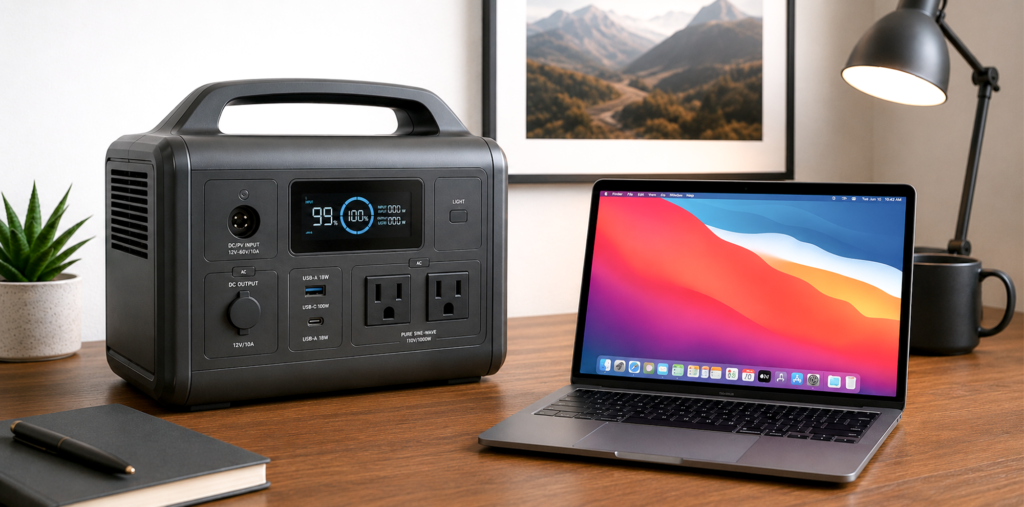
Best Portable Power Stations of 2026
Ten units we'd actually plug a workday into – from a 286Wh desk backup to a 4kWh whole-home system. All LiFePO4.
A portable power station is the difference between a blackout that quietly ends your workday and one you barely notice. It is a big lithium battery with real wall outlets: plug in your laptop, monitor, router and a lamp, and keep working straight through an outage that would otherwise cost you the call, the render, or the file you forgot to save.
Deciding between a power station and a traditional UPS for your desk? Start with what size UPS you actually need – the watts-first math there applies to both.
This matters more every year. Grid reliability is trending the wrong way, storms are getting rougher, and more of us work from home — where a dead router means a dead paycheck. The good news is that a portable power station earns its keep the other 360 days too: running your setup on the patio, powering a weekend of camping, or keeping the fridge cold until the lights come back.
If you have read our best UPS battery backup guide, think of a power station as the bigger sibling. A desktop UPS buys you a few minutes to save your work and shut down safely; a portable power station buys you a full workday. In independent testing, a single 1kWh unit routinely runs a laptop, monitor and router for eight to ten hours with charge to spare, and many now include a sub-10ms UPS switchover so they deliver that instant-cutover protection too.
We compared the portable power stations you can actually buy on Amazon right now — from a 286Wh grab-and-go unit to a 4kWh whole-home system — and picked one clear winner for every kind of buyer. Every pick below uses a long-life LiFePO4 battery, and we flag which carry a Prime badge versus shipping as freight from the brand.
Portable Power Stations: The 30-Second Answer
Short on time? The EcoFlow Delta 2 is the best all-rounder for most home offices — about 1kWh, an 1,800W inverter, a 50-minute recharge and room to expand, with by far the largest owner review base here. The GRECELL H1200 does the important parts for a good deal less and is our value pick. Need something tiny and cheap just to keep a laptop, router and lamp alive? The Westinghouse iGen400s weighs five pounds and tucks into a bag. And if you want to back up the whole house — fridge, furnace, the works — the EcoFlow Delta Pro 3 is the one to wire in.
Best Portable Power Stations 2026 at a Glance
| Model | Capacity | Output (cont.) | Best For |
|---|---|---|---|
| EcoFlow Delta 2 | 1,024Wh | 1,800W | Best overall |
| GRECELL H1200 | 672Wh | 1,200W | Best value |
| Westinghouse iGen400s | 183Wh | 200W | Best compact / budget |
| AFERIY P280 | 2,048Wh | 2,800W | Fastest charging |
| AFERIY 1024Wh | 1,024Wh | 1,800W | Lightest 1kWh |
| Jackery Explorer 300 | 292Wh | 300W | Camping trips |
| Jackery HomePower 3000 | 3,072Wh | 3,600W | Plug-in home backup |
| Jackery Explorer 2000 Plus | 2,042Wh | 3,000W | Best expandable |
| EcoFlow Delta 3 Ultra Plus | 3,072Wh | 3,600W | Best large expandable |
| EcoFlow Delta Pro 3 | 4,096Wh | 4,000W (120/240V) | Best whole-home backup |
Prices are approximate and move often, especially around sales events — check the live price on each card below.
How We Picked These Portable Power Stations
Two numbers matter most. Capacity (watt-hours) tells you how long a unit runs; output (watts) tells you what it can run at once. We balanced both against price rather than chasing headline capacity. We favored LiFePO4 (LFP) batteries, which last roughly 3,000–4,000 charge cycles — about a decade of daily use — versus a few hundred for the older lithium chemistry. Nine of the ten here use LFP cells; the one budget camping pick does not state its chemistry on the listing, and we say so in its own section rather than assuming. We weighted a fast, sub-20ms UPS switchover heavily, because that is what actually protects a PC or NAS from a hard crash when the grid drops. And we checked fulfilment on every listing individually, reading the live Amazon buy box rather than trusting a cached field. That turned out to matter more than any spec on this shelf: most of the best-known power stations are sold through the brand’s own Amazon storefront on multi-day freight with no Prime offer at all. Every pick below is sold by Amazon itself and was Prime-eligible when we checked on August 11, 2026.
1. EcoFlow Delta 2 — Best Overall

- Full Charge in 56 Min. With DELTA3’s upgraded technology combining 500W solar input and 1500W max AC input, a full charg…
- Flexible Expansion up to 5kWh. The DELTA 3 Series integrates with EcoFlow’s ecosystem, allowing expansion up to 5kWh wit…
- Durable and Reliable for 10 Years. Powered by LiFePO4 (LFP) cells, with 4000 cycles to 80%, offering 25% more durability…
1,024Wh LiFePO4 · 1,800W · 15 outlets · expandable to 3kWh · 27 lb
The Delta 2 is the one we would put on most home-office desks, and it is also the most thoroughly reviewed unit on this list by a wide margin — thousands of owner ratings rather than dozens, which matters more than any spec when you are buying a battery you expect to still trust in five years. It carries 1,024Wh behind an 1,800W inverter, which is enough to run a full workstation, a monitor and a router through a long outage, and it refills faster than almost anything here: 0–80% in about 50 minutes and full in roughly 80 on a wall outlet.
Where it wins is balance. Fifteen outlets, up to 500W of solar input, LiFePO4 cells rated past 3,000 cycles, and expansion to 3kWh if your needs grow — so the unit adapts instead of forcing a replacement. EcoFlow includes a five-year customer service commitment, which is long for this category.
The honest trade-offs: the 1,800W continuous ceiling is generous for electronics but will not carry a space heater and a microwave together, the expansion batteries are a real added cost, and at 27 pounds this is luggable rather than portable.
Who it is for: anyone who wants one do-it-all unit for weekday outages and weekend trips, and who wants the reassurance of a very large review base.
2. GRECELL H1200 — Best Value

- 1200W AC Output for Most Home & Outdoor Devices: Featuring 2 AC outlets (120V/60Hz, 1200W continuous power), this portab…
- LiFePO4 Battery 3000+ Cycles for Long-Lasting Use: Equipped with high-quality lithium iron phosphate (LiFePO4) battery, …
- All-in-One Power Hub: With 10+ ports (2*AC, 2*USB-C 100W, 2*USB-A 18W, 1*DC 12V, 1*Car cigarette lighter 120W), you can …
672Wh LiFePO4 · 1,200W · 10ms UPS · 400W solar input · 25.4 lb
This is the cheapest way on this list to get the two things that actually matter for a home office: lithium iron phosphate cells and a genuine 10ms UPS switchover. That combination means it can sit permanently between the wall and your desk, carry the load the instant the grid drops, and still be healthy after 3,000-plus charge cycles — roughly three times the cycle life of the ternary lithium packs used in cheaper units.
The 1,200W continuous output covers a desktop, two monitors, a network stack and a mini-fridge, and there are more than ten ports including two 100W USB-C. It takes up to 400W of solar, folds its handle flat for storage, and is rated to operate from 14°F to 104°F, which matters if it lives in a garage or a car trunk.
The honest trade-offs: 672Wh is a modest tank — it is a bridge through an outage, not a day off-grid. There are only two AC outlets, and the solar cable is sold separately.
Who it is for: anyone who wants true UPS behavior and long-life cells without paying four figures.
3. Westinghouse iGen400s — Best Compact and Budget Pick

- PORTABLE POWER: The iGen400s portable power station is a lightweight lithium battery generator that delivers quiet, fume…
- MULTIPLE OUTLETS: 9 outlets so you can power a range of devices all at once, including 2 120V AC outlets, 3 USB-C 30W po…
- FAST CHARGE: Charge to 80% in 2 hours from a 120V outlet with the included USB-C cable, if using a 100W AC power adaptor…
183Wh · 400W peak, 200W running · 9 outlets · 5 lb
At five pounds this is the only unit here you would actually carry somewhere without thinking about it, and that is the entire point. It is sized for a laptop, a phone, a router and a lamp — the things that keep you working and reachable when the power goes — not for appliances. Nine outlets is unusually generous for the size, including a 100W USB-C port that will charge a modern laptop at full speed.
It runs silent with no fumes, so it is safe indoors, and it carries protections against overcharging, overloading, overheating and low voltage. There is a tri-mode flashlight built in, which sounds like a gimmick until the outage is at night.
The honest trade-offs: 200W of running output is the real ceiling, and 183Wh will not go far — think hours of laptop use, not days. Note that no AC power adapter is included; it charges over USB-C, and you will want a 100W adapter to hit the quoted two-hour 80% figure.
Who it is for: anyone who wants cheap, light insurance for the desk, or a travel unit that fits in a bag.
4. AFERIY P280 — Fastest Charging
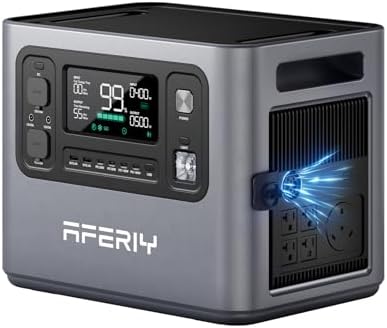
- 【Blazing-Fast Charging – No More Waiting on Trips】The AFERIY P280 Solar Generator comes with 1800W AC input and 1200W PV…
- 【Forget Refueling】Boasts 2048Wh LFP battery capacity, expandable to 10.24kWh with extra batteries,providing 2 days of wh…
- 【Dual PV Inputs – Easy DIY】The AFERIY P280 Power Station supports dual PV inputs. It lets you get multi-channel DC input…
2,048Wh LiFePO4 · 2,800W (5,600W peak) · 0–80% in 38 minutes · expandable to 10.24kWh · 44 lb
Nothing else here refills like this. With 1,800W of AC input the P280 goes from empty to 80% in about 38 minutes, which changes how you use a power station — you can top it up in the gap between two outages rather than waiting half a day. The 2,800W inverter is the second highest on this list and handles power tools and full-size appliances, not just electronics.
It also has the most flexible solar arrangement here: dual PV inputs accepting up to 1,200W total, so you can run two arrays without an external MPPT controller. The UPS responds in under 10ms, the cells are rated past 4,000 cycles, and capacity expands to 10.24kWh with extra batteries for genuine multi-day backup.
The honest trade-offs: 44 pounds is a two-hands-and-a-plan lift. It is also the newest listing on this page with only a few dozen owner ratings, so the long-term reliability record is thin compared with the Jackery and EcoFlow units — worth weighing if that matters more to you than charge speed.
Who it is for: people who want the fastest possible turnaround and room to grow into a whole-home system.
5. AFERIY 1024Wh — Best Lightweight 1kWh

- 【4000+ Cycles & 10-Year Lifespan】Delivering 1800W AC output and 1024Wh capacity, this portable power station features a …
- 【16% Smaller & 25% Lighter】This solar generator measures only 13.77×8.66×10.35 inches and weighs just 25.57 lbs—making i…
- 【<10ms UPS, 2X Faster Than Standard Models】In storms, hurricanes, or sudden outages, the built-in UPS switches in <10ms—...
1,024Wh LiFePO4 · 1,800W (3,600W peak) · 13 ports · under 30dB · 25.6 lb
Same capacity and same 1,800W output as our top pick, in a noticeably smaller and lighter box — 13.77 by 8.66 by 10.35 inches and 25.6 pounds, which the maker puts at around 16% more compact and 25% lighter than typical 1kWh units. If the station has to live on a desk or a shelf rather than on the floor, that difference is the whole argument.
It is also the quietest unit here at under 30dB, has a sub-10ms UPS, and offers four charging routes including AC-plus-solar together, which takes it to 80% in about 35 minutes. Thirteen ports include four AC outlets and a 140W USB-C. The cells are rated beyond 4,000 cycles and there is an app for scheduling and monitoring.
The honest trade-offs: the review base is small, so treat the long-term record as unproven. Some of the convenience features run through the companion app, which is a dependency the simpler units here do not have.
Who it is for: anyone who wants a full kilowatt-hour on a desk without a floor-standing box, and who values silence.
6. Jackery Explorer 300 — Best for Camping Trips

- Ultra-Lightweight: At only 7.5 lbs, the Explorer 300 delivers a robust 292Wh capacity while remaining 17% lighter than t…
- Versatile Power for 6 Devices: Equipped with 2 AC outlets, a 100W USB-C PD port, 2 USB-A ports, and a 120W car port. Wit…
- Built to Last: Upgraded with premium LiFePO4 chemistry, this portable generator delivers over 4,000 charge cycles before…
292Wh · 300W output · 6 ports · 7.5 lb
At 7.5 lb this is the lightest unit on the page and the easiest to drop in a car. The 300W output covers laptops, camera batteries, lights and a phone-charging run rather than anything with a motor, so treat it as a weekend-camping and power-cut unit rather than a home backup. Six ports cover it: two AC outlets, a 100W USB-C PD port that charges a laptop at full speed, two USB-A and a 120W car port. The LiFePO4 cells are rated beyond 4,000 charge cycles, several times the older lithium-ion packs at this size, and at 4.6 stars from 11,184 ratings it carries by far the deepest owner evidence of anything here.
Two built-in LED panels, in white and amber, double as camp or emergency lighting, and there is a battery management system handling charge and discharge protection.
The honest trade-offs: the solar input tops out at 120W, so recharging from panels is slow compared with the bigger units here. The 500W ceiling rules out appliances, and unlike the H1200 the listing does not specify lithium iron phosphate cells, so expect a shorter cycle life.
Who it is for: weekend trips, tailgates and a light desk backup, where weight matters more than capacity.
7. Jackery HomePower 3000 — Best Plug-In Home Backup
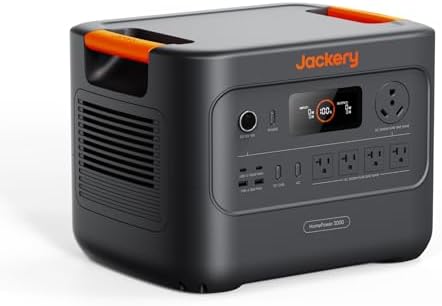
- Essential Home Backup: With a robust 3600W output (7200W surge) and a 3072Wh capacity, the Jackery HomePower 3000 provid…
- ≤20ms UPS: Featuring a UL-certified UPS that switches seamlessly within ≤20ms, the Jackery HomePower 3000 Portable Power…
- Power for Essentials: The Jackery HomePower 3000 keeps your essentials charged at once with versatile AC, USB-C, USB-A, …
3,072Wh LFP · 3,600W (7,200W surge) · UL-certified UPS · full recharge in 1.7 hours · 59.5 lb
This is where a power station stops being a desk accessory and starts being house infrastructure. A 3,600W output with a 7,200W surge headroom will start a fridge compressor, and 3,072Wh will keep the fridge, the router, the lights and a work setup going through a long evening outage rather than an hour of it.
Two things separate it from the other large units. The UPS is UL-certified rather than merely specified, which is a meaningful distinction for medical or security equipment. And Jackery uses cell-to-body construction to make it markedly smaller and lighter than the usual 3kWh box — the company claims 47% smaller and 43% lighter than comparable models. It refills in about 1.7 hours on hybrid AC and DC.
The honest trade-offs: the UPS switches in up to 20ms, which is slower than the sub-10ms units above — fine for a fridge, worth checking against a desktop PC without its own small UPS. And at 59.5 pounds it goes where you put it and stays there.
Who it is for: households that want real outage coverage for essentials, not just a desk that stays alive.
8. Jackery Explorer 2000 Plus — Best Expandable

- Magnificent Performance: Featuring up to 2,042.8 Wh gigantic capacity, the Jackery 2000 Plus Power Station can power a r…
- Ultra Fast Charging: Charge directly from the sun or via wall outlet, conveniently, quickly and additionally worry free….
- 2kWh – 24kWh Flexible Expansion: The Jackery Explorer 2000 Plus supports up to 5 expandable battery packs, featuring pow…
Check the buy box before ordering. Amazon is not currently showing a default offer on this listing, so you may need to open See All Buying Options and choose a seller yourself. Checked August 31, 2026.
2,042Wh LiFePO4 · 3,000W · expandable to 12kWh (24kWh in parallel) · UPS · ~$1,499
The 2000 Plus is the one to buy if you want to start reasonable and grow toward whole-home over time. It starts at 2kWh and 3,000W — enough to run heavy loads like a window AC or power tools — and accepts up to five expansion batteries to reach 12kWh. Connect two units in parallel and you get 240V and 6,000W. That modularity, plus a mature accessory ecosystem, makes it a genuine long-term platform rather than a single-purchase dead end.
The honest trade-offs: you pay for the expansion headroom whether or not you use it, so this is only the right buy if you genuinely intend to scale beyond a single unit — the AFERIY P280 above holds a similar base capacity for less. The expansion batteries themselves are a significant added cost on top, and at this size the unit is heavy enough that it lives where you put it.
Who it is for: buyers who want to begin at 2kWh and build toward multi-day or whole-home backup on their own timeline.
9. EcoFlow Delta 3 Ultra Plus — Best Large Expandable
- Easily Scales Up. Adapt power to your lifestyle with expandable capacity from 3kWh to 11kWh. Add extra batteries to cove…
- Built to Handle It All. Unleash 3600W of continuous power (surge 7200W) with X-Quiet 3.0 technology—strong enough for he…
- <10ms UPS for Uninterrupted Backup. Stay connected when it matters most. DELTA 3 Ultra Plus automatically switches to ba...
Delivery note: this one currently ships from a marketplace seller rather than from Amazon. The listing is genuine and the price is live, but delivery and returns run through that seller rather than through Amazon. Checked August 31, 2026.
3,072Wh LiFePO4 · 3,600W (7,200W surge) · expandable to 11kWh · <10ms UPS · ~$1,899
This is the pick for serious multi-day backup that you do not want to hard-wire into your electrical panel. It pairs a big 3,072Wh base with a fast, sub-10ms UPS switchover and a strong 3,600W output (7,200W surge), and it scales to 11kWh with extra batteries for genuinely long outages or off-grid stints. EcoFlow’s X-Stream charging still brings it to 80 percent in under an hour despite the size.
The honest trade-offs: this is a freight item — it ships directly from EcoFlow, is marked non-returnable, and does not carry a Prime badge. It is also heavy. You are buying capacity and a fast cutover, not grab-and-go portability.
Who it is for: people who want multi-day, high-output backup with a fast UPS, but prefer a plug-and-play tower to a wired-in system.
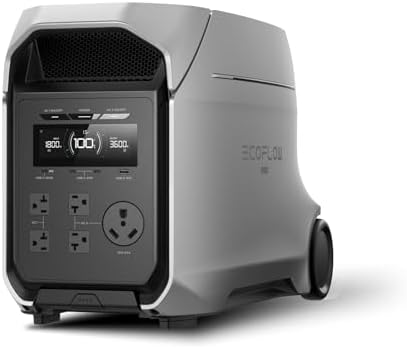
10. EcoFlow Delta Pro 3 — Best Whole-Home Backup

- Energize Almost Everything. The EcoFlow DELTA Pro 3 supports 120V/240V voltage and has a 4000W output (6000W with X-Boos…
- Forget Refueling. Featuring a 4096Wh LFP battery capacity, expandable to 48kWh with extra batteries or smart generators,…
- Plug and Play. Experience hassle-free power with the DELTA Pro 3, a versatile portable power station that’s easy to set …
4,096Wh LiFePO4 · 4,000W (6,000W X-Boost), 120/240V · expandable to 48kWh · 10ms UPS · ~$2,999
This is the endgame. The Delta Pro 3 delivers native 120V/240V split-phase power at 4,000W, so with a transfer switch it can back up the circuits a normal power station cannot — a well pump, an electric range, or a central AC with sensible load management. Its 4,096Wh base expands to a huge 48kWh, giving two to four days of whole-home backup, and the 10ms switchover makes it a true UPS for NAS units, servers and the rest of a connected home.
The honest trade-offs: it is expensive, it is heavy (this is a wheeled unit, not a carry), and it ships as freight rather than Prime. It is genuine overkill unless you specifically want house-level backup — but if you do, nothing here comes close.
Who it is for: homeowners who want real whole-home or essential-circuit backup and are ready to invest in it.
How to Choose a Portable Power Station
Buying a portable power station comes down to a few numbers and one honest question about how you will really use it.
Capacity vs. output. Capacity, in watt-hours (Wh), is how long it runs. Output, in watts (W), is what it can run at once. A 1,000Wh unit at 1,800W can power a whole desk for hours but cannot start a large motor; a 2,000Wh unit at 3,000W runs heavier appliances for longer. Match both to your actual needs rather than buying on capacity alone.
Battery chemistry. Insist on LiFePO4 (LFP). Every pick here uses it, and it lasts roughly 3,000–4,000 cycles — about ten years of regular use — versus a few hundred for older lithium cells.
UPS switchover. If you want the station to protect a PC or NAS, look for a sub-20ms (ideally sub-10ms) UPS switchover. That is the window between the grid dropping and the battery taking over; faster is safer for sensitive electronics.
Ports, solar and weight. Check that it has enough AC outlets and USB-C PD ports for your gear, whether it accepts a solar panel for multi-day outages, and how heavy it is if you plan to move it around.
Prime vs. freight. Mid-size units ship Prime from Amazon; the biggest whole-home units usually ship as freight from the brand and may be non-returnable. Neither is a problem — just know which you are buying.
A quick sizing formula: add up the watts you must run, multiply by the hours you need them, and divide by about 0.85 for efficiency losses. That is roughly the capacity to look for.
Building out the rest of your setup? See our guides to the best desktop computers, home office monitors and Wi-Fi routers — and pair any power station with a UPS battery backup for instant, always-on protection at the desk.
Portable Power Stations: Frequently Asked Questions
What can a portable power station run in a home office?
A 1kWh unit comfortably runs a laptop, monitor, router and a lamp for most of a workday. Step up to 2kWh to add a refrigerator or ride out a longer outage. A small 300Wh unit keeps just your internet and laptop alive for a few hours.
What size power station do I need?
Add up the watts of everything you must run, multiply by the hours you need, and divide by about 0.85 for efficiency. Most home offices are well served by 1–2kWh; whole-home backup starts around 3kWh and should ideally be expandable.
Do I need a portable power station or a UPS?
A UPS buys you a few minutes to save your work and shut down safely; a power station buys you hours to keep working. Many stations now include a fast UPS switchover, so they can do both jobs. Our UPS battery backup guide covers the desk-level option in detail.
Are portable power stations safe to use indoors?
Yes. Unlike gas generators, battery power stations produce no fumes and very little noise, so they are designed to be used safely indoors during an outage.
How long do portable power stations last?
The LiFePO4 batteries in every pick here are rated for roughly 3,000–4,000 charge cycles while retaining about 80 percent of their capacity — around a decade of regular use.
Can I recharge one with solar panels?
Yes. Every model here accepts an optional solar panel, which is useful for multi-day outages and off-grid use. Panels are almost always sold separately, so factor that into the cost.
Why are so many big-brand power stations not Prime?
These are large lithium batteries, which Amazon treats as hazardous materials, and most brands sell them through their own Amazon storefront on a slow ground network rather than through Amazon itself. The practical result is a multi-day delivery window instead of a Prime date, and many are marked non-returnable. It is not a sign of a bad product — several excellent units ship this way — but it does mean slower delivery and a harder return, so every pick on this page is one Amazon sells and ships directly.
Can a portable power station run my whole house?
Only the largest, 240V-capable units — like the EcoFlow Delta Pro 3 — can, and usually through a transfer switch with careful load management. Most portable stations are built to power essential devices and appliances, not your entire electrical panel at once.
Why You Can Trust Smart Tech Buying
Every recommendation is based on extensive product research, manufacturer specifications, customer feedback, long-term reliability, value, and suitability for real-world use. When we have personal experience with a product, we include those insights. We regularly review our guides to keep recommendations current as new products are released.